
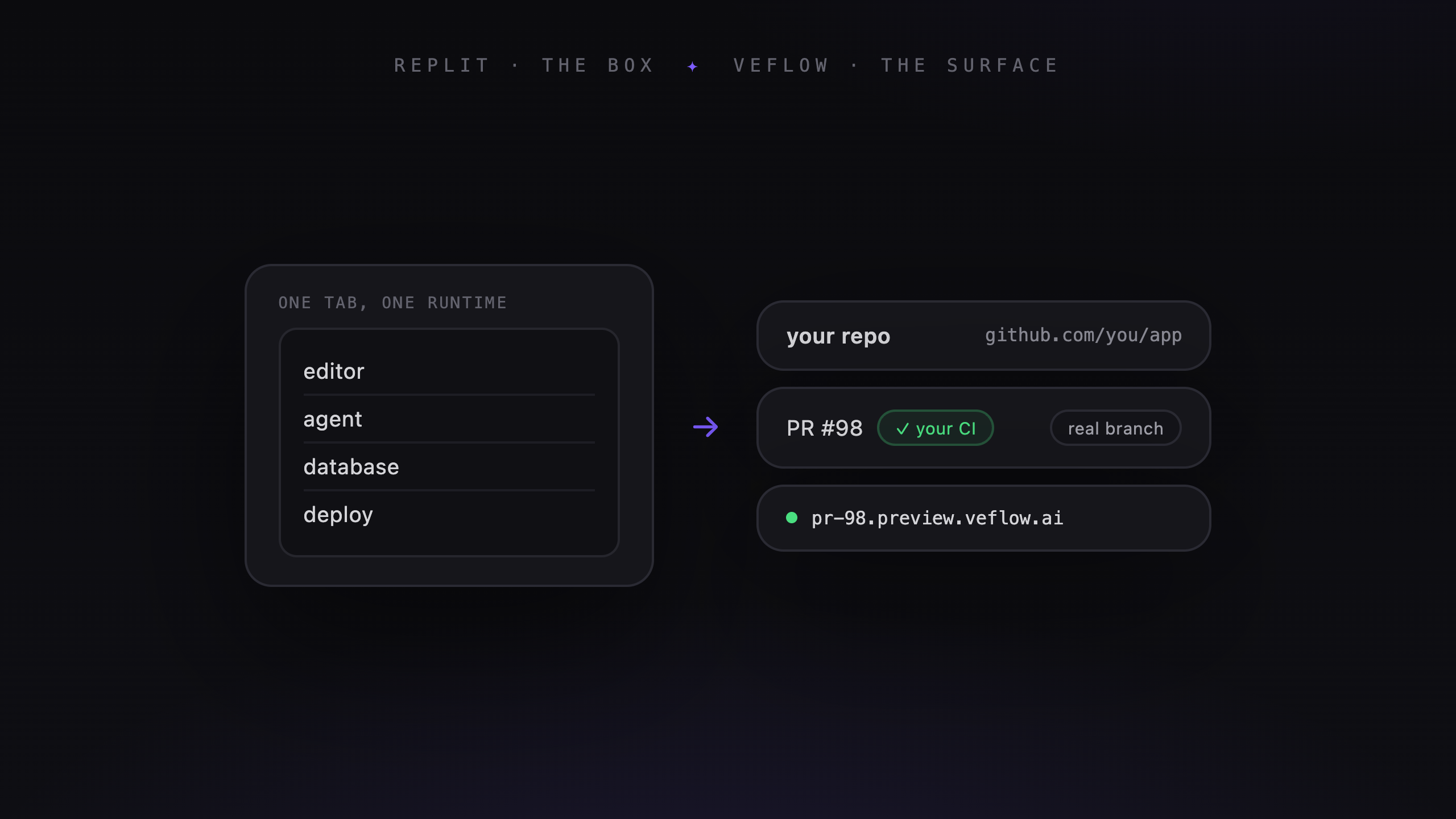
Teams searching for a Replit Agent alternative usually hit the same wall: Replit collapses the editor, runtime, and agent into one proprietary tab, and there is no clean exit when the project outgrows it. Veflow takes the opposite position — AI agents run against your real GitHub repo, output real PRs your team reviews, and your existing CI and hosting never move. From a distance the two products look alike; up close they're almost opposites.
The disagreement is about where the workspace ends.
What Replit Agent does well
Real credit, not pre-buttered praise:
- The "from zero to a running thing" loop is genuinely best in class. You type a prompt, you watch an app appear, you click a link, it works. Agent 3 will provision the database, wire up auth, configure a Stripe webhook, and write tests on the way. The friction is close to none.
- One tab, one runtime, one URL. No GitHub configuration, no Vercel project setup, no CI pipeline. The editor, the agent, the database, and the deploy are the same product — with real deployment options underneath (autoscale, static, scheduled, reserved VMs).
- The learning curve is flat. Someone who has never touched a Git workflow can ship a working app on Replit in an afternoon. That's a real achievement.
If you're building something new, alone, and the value of the thing is in shipping it tomorrow rather than living with it for two years, Replit Agent is hard to beat.
What Veflow does well
The other side:
- Your repo stays your repo. Veflow runs against a real GitHub repository. The branches are real branches, the PRs are real PRs, the merges are GitHub merges. If Veflow vanished tomorrow your project would be untouched.
- Your stack stays your stack. Veflow auto-detects npm-based dev servers — Next.js, Nuxt, Vite, Astro, Express — and anything else runs via a small
veflow.yml. You don't rebuild your project around our runtime. - The artefact is a PR, not a project. Every task ends in a reviewable, mergeable diff that lives in your existing GitHub history forever. The work product is durable in the place your team already trusts.
The price: you pay for the indirection. There is a GitHub account, there is a CI workflow, there is a package.json you can break. Veflow does not protect you from your own stack the way Replit does.
Key difference #1 — does the agent own the runtime?
This is the cleanest way to see the disagreement.
On Replit, the agent owns the runtime. It's the same box: the agent writes the code, the runtime runs the code, the URL serves the code. There is no "deploy" in the traditional sense because nothing ever left.
On Veflow, the agent does not own the runtime. The agent writes code into a real branch. Veflow's container infrastructure spins up a preview for that branch — a fresh, isolated runtime, every time. When the PR merges, your existing deploy pipeline takes over.
The Replit bet: collapsing the runtime makes everything faster. The Veflow bet: separating the runtime makes everything portable.
Both are right under the right conditions. Neither is right under all of them.
Bet #2 — where does your team's source of truth live?
If you've ever onboarded a senior engineer to a new codebase, you know how much trust the engineer places in git log. Years of decisions, attributed to people, with the diffs that made them. That history is load-bearing.
Replit's source of truth is the workspace. The project is the workspace; the workspace is the project. The Git integration is real — you can import from and push to GitHub, agent changes land as commits you can revert or branch from — but the centre of gravity is the Replit project, not the Git history.
Veflow's source of truth is your repo. Veflow is a lens onto it. Every chat, every tool call, every decision is linked to a branch and a PR in your GitHub history. Six weeks from now you can read the merged PR and trace it back to the brief that started it — without Veflow being in the picture.
If your team has zero existing investment in git log as the system of record, Replit's collapsed model is more ergonomic. If you have years of it, Veflow's separation is the safer bet.
Key difference #3 — solo builder or an engineering team?
Replit Agent was built — and is at its best — for one person building a thing.
Veflow was built for the loop where work is dispatched to specialised agents (Atlas for full-stack, Nova for backend, Orion for API/infra), runs against a shared repo, opens PRs that humans review, and gets merged through a shared workspace. The unit is the team, not the builder.
This shows up in small places:
- Veflow PRs land in your existing review process. Whoever your team already reviews with reviews here too. Replit's flow is centred on the builder iterating in the workspace.
- Veflow's durable task history means a teammate joining a feature six weeks late can read the original brief, see the agent's plan, scroll the tool calls, and know what happened. Replit's tab-as-workspace doesn't carry that across people as well.
- Veflow's multi-agent roster matches how teams already split work. Replit's single workspace asks the agent to be a generalist.
For a solo builder, this all looks like overhead. For a team, it's the point.
Where Replit Agent is the right call
Be honest with yourself:
- You're prototyping. Idea-to-thing-on-the-internet in an afternoon. Replit will beat Veflow on this all day.
- You want zero infra. You don't want to think about GitHub, CI, hosting, or domains until you have to. Replit's collapsed model removes the choice.
- The artefact's lifetime is short. Demos, throwaway tools, things that exist to make a point and then get archived. Optimising for portability costs you here.
- You're learning. Replit is one of the best products in the world for "watch an app come together while you read what the agent is doing."
If those describe you, go to Replit. Not a defensive recommendation — a genuine one.
Where Veflow is the right call
- You ship into an existing codebase. The work is changes to a real repo with real history, not greenfield. The unit of work is a PR, not a project.
- You already have CI, hosting, and observability. Switching to a collapsed workspace costs you those investments. Veflow lets you keep them.
- More than one person reads the diff. The review loop is the point, and it has to be fast across people who aren't the writer.
- AI agents do most of the writing. The need for durable context — what was attempted, what got reverted, why this approach over that one — gets sharp when the writer doesn't remember.
How to actually decide
A pattern we've seen work: pick one task you'd genuinely ship, and ask whether it ends as a PR in your team's repo or as a project in a vendor's workspace. If the answer matters to you — and it does for most teams past one developer — that's most of the decision made.
