Teams looking for a Paperclip alternative often land here because both products involve AI agents doing software work — and from a distance that sounds like the same category. Paperclip is one of the fastest-growing open-source agent projects of the year, with 50k+ GitHub stars within weeks of launch, so the question is fair. But up close, the two products are solving different problems at different layers of the stack.
Up close, the two products answer different questions. Paperclip's question is "how do I run a team of agents?" Veflow's question is "how do I ship a code change an agent wrote?" Those overlap in exactly one place — coding tasks — and diverge everywhere else. This is an honest map of the line.
What Paperclip actually is
Paperclip is an MIT-licensed, self-hosted orchestration platform — a Node.js server with a React dashboard — that wraps your AI agents in a company structure. Their own framing is the best summary: the mental model is a company you are running, not a tool you are using.
Concretely:
- An org chart. Agents have roles, titles, reporting lines, and job descriptions. You can have an agent CTO delegating to agent engineers, an agent marketer, an agent QA.
- Bring-your-own agents. Paperclip doesn't ship agents; it orchestrates the ones you already run via adapters — Claude Code, Codex, Cursor, webhook bots, bash CLI agents, anything that can receive a heartbeat.
- Heartbeats. Agents wake on schedules, check their queue, and act. The default mode is scheduled autonomy, not a human pressing "go."
- Hard budgets. Every agent gets a monthly spend cap. At 100%, it stops. Per-agent, per-project, per-provider cost tracking.
- Governance. Board-style approvals, pause/resume/terminate, an immutable append-only audit log of every tool call and decision.
It's a genuinely well-built take on agent management. If your problem is "I have five agents doing different jobs and no idea what they cost or who approved what," Paperclip is a strong answer — and it's free and self-hosted, so trying it costs you an afternoon.
What Paperclip deliberately is not
This isn't us spinning a weakness — it's their own scope statement. From the Paperclip README: it is not a code review tool. Their line: "Paperclip orchestrates work, not pull requests. Bring your own review process."
So when a Paperclip agent finishes a coding task, the loop that follows — see the diff, run the change, click through the app, merge — happens somewhere else. In your terminal, in GitHub, in whatever review process you brought.
That somewhere else is exactly the part Veflow is.
Agent manager vs change manager: what's the central object?
The cleanest way to see the difference is to ask what the product's central object is.
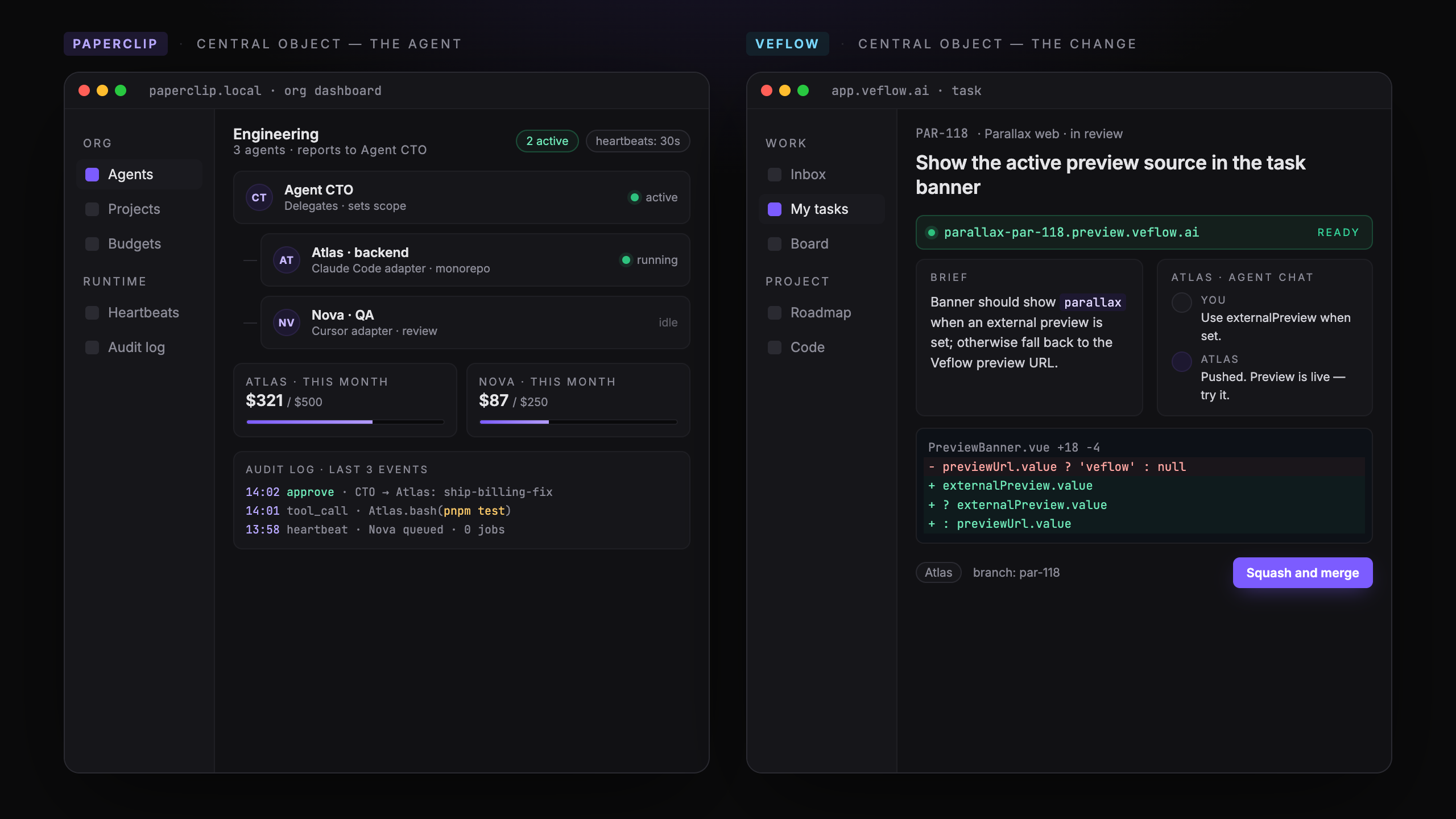
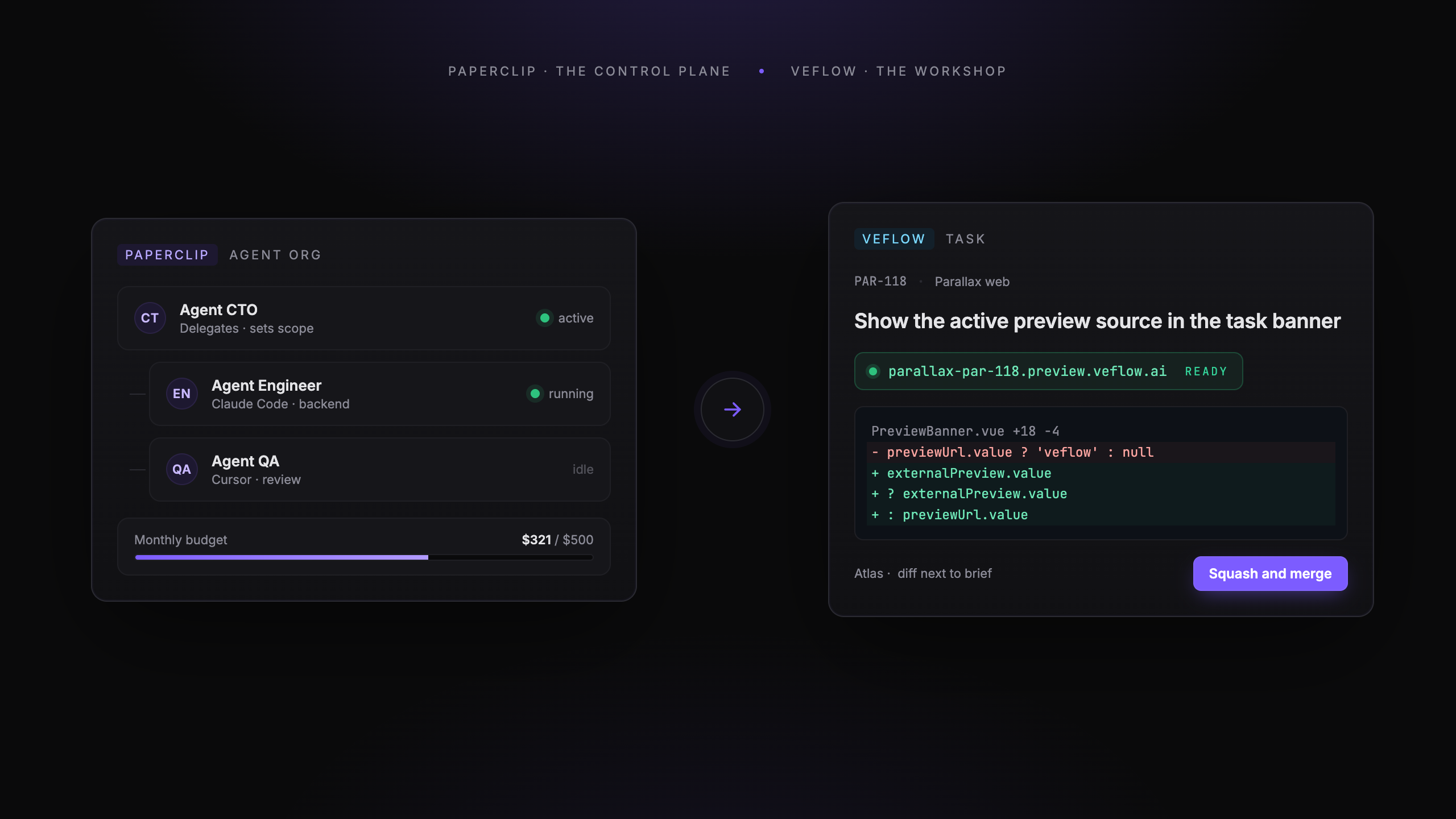
Paperclip's central object is the agent. The dashboard is an org chart. The questions it answers: who works for whom, what is everyone doing, what does it cost, who approved it.
Veflow's central object is the change. A task in Veflow owns a brief, an agent chat, a branch, a live preview URL, a diff, and a PR with a merge button. The questions it answers: does this change match the brief, does it actually run, can I ship it now.

Two central objects. Paperclip organises agents; Veflow organises changes.
Neither is wrong. They're different layers. But it means comparing them feature-for-feature mostly produces "N/A" in both columns — Paperclip has no preview URLs and no diff review; Veflow has no org chart and no per-agent budget caps.
Bring your own agents, or batteries included
Paperclip assumes you already run agents — Claude Code in a terminal, Codex, Cursor — and gives you the management layer above them. You operate the runtimes; Paperclip coordinates them. That's powerful and flexible, and it's also real operational surface: adapters to wire, machines to keep running, heartbeats to schedule.
Veflow ships the agents and the runtime. Atlas (full-stack), Nova (backend & systems), and Orion (API & infra) run hosted, against your GitHub repo, with the execution environment provisioned per task. You write a brief and assign; there is nothing to self-host.
The trade is the classic one: Paperclip gives you control and asks for operations; Veflow gives you a closed loop and asks for trust in our defaults.
Bet #3 — where does review live?
This is the bet we care most about, and it's where the two products genuinely disagree rather than just occupying different layers.
Paperclip's position — bring your own review process — is coherent for a tool that orchestrates marketing agents and research agents alongside coding agents. Review means something different in every one of those domains, so the platform stays out of it.
Our position: for code, the review loop is the product. When the writer is an agent, "does it actually work?" is the question everything hangs on, and answering it needs infrastructure:
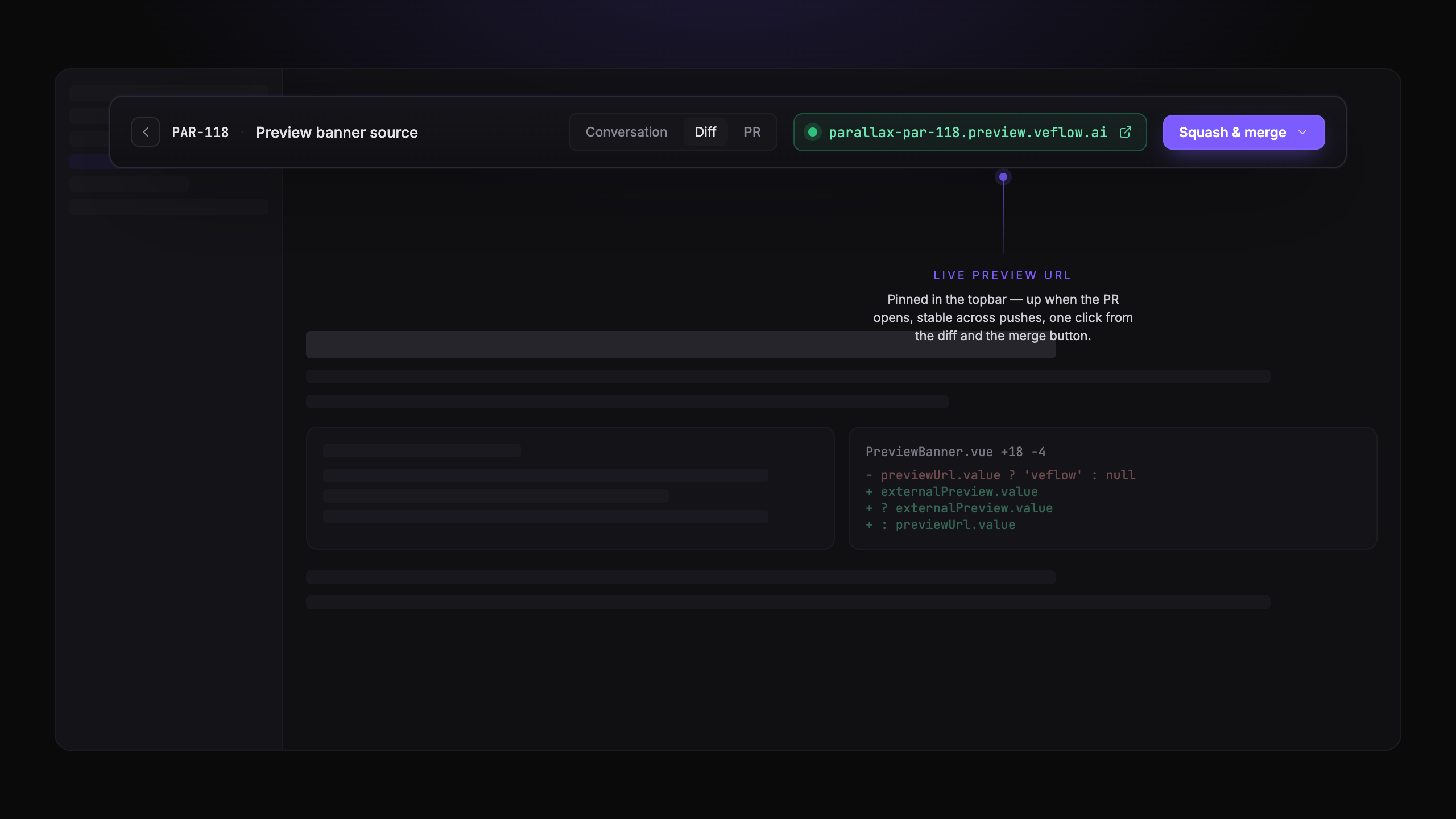
- A live preview URL per task, up when the PR opens, stable across pushes, one click from the diff.
- The diff next to the brief, so "does it match what we asked for?" is a scroll, not a tab-switch.
- Merge from the topbar — merge commit, squash, or rebase — landing as a real GitHub merge in your repo.
If your agents ship code and your review process is "the founder reads the diff in GitHub and hopes," the orchestration layer above it won't save you. The loop below it will.

The preview URL lives in the topbar, one click from the diff and the merge button.
Bet #4 — self-hosted control plane, or hosted workspace
Paperclip is MIT-licensed and self-hosted: your server, your Postgres, your data, no vendor account. For teams with infra muscle and data-locality requirements, that's a real advantage and we won't pretend otherwise.
Veflow is hosted, because the part we consider non-negotiable — per-task preview infrastructure that boots your app in an isolated container, on a stable URL, in seconds — is exactly the part that's miserable to self-host. We made the opposite trade: zero operations for you, in exchange for running on our infrastructure. Your code's source of truth stays in your GitHub either way; if Veflow vanished tomorrow, your repo, branches, and merged PRs would be untouched.
Where Paperclip is ahead
Honest comparison means saying where the other product wins.
- Cost control. Per-agent monthly budgets with hard stops. Veflow has nothing equivalent today, and for autonomous agent fleets this matters a lot.
- Open source and self-hosted. MIT license, your hardware, no lock-in, free.
- Governance depth. Board approvals and an immutable audit log designed for agents acting with real autonomy.
If your priorities are self-hosting, hard spend caps, and governance over a semi-autonomous agent fleet, start with Paperclip.
Where Veflow is ahead
- The shipping loop. Brief → agent → live preview → diff → merge, on one screen. Paperclip ends where this begins.
- Preview infrastructure. An isolated, running instance of your app per task, with a stable URL, built in. This is the hardest thing we've built and the thing no orchestration layer gives you.
- Zero operations. No server, no adapters, no agent runtimes to babysit.
- GitHub-native artefacts. Every task ends as a real PR in your repo. The durable record of what shipped and why lives in the system your team already trusts, alongside the full agent transcript on the task.
If your goal is shipping reviewed, working code changes with agents doing the writing, that's the loop we built.
The non-obvious answer: they compose
Because the products sit at different layers, "vs" is slightly the wrong word. An agent org in Paperclip needs somewhere for its coding work to become reviewed, running, merged software — and Veflow's whole job is being that somewhere. We'd genuinely rather you run Paperclip above Veflow than force either tool to do the other's job badly.
But if you're choosing where to start, choose by your bottleneck. If you can't tell what your agents are doing or costing: Paperclip. If agent code is piling up unreviewed and unverified: Veflow.
Pick one real task you'd actually ship and run it end-to-end. Friction is the signal.